
When researching and making pieces for her exhibition at Compton Verney, the artist Renee So drew inspiration from the bronze mirrors in the Chinese collection. So’s research led her to commission a ‘magic mirror’ which you can see in the exhibition, Commodities, until Sunday 8 March
In this blog, one of Compton Verney’s tour guides, Jane Hornby, explains the significance of mirrors, what a ‘magic mirror’ is and takes a closer look at the bronze mirrors in Compton Verney’s Chinese collection.
Four thousand years of mirror-making
Bronze mirrors have been made in China for approximately 4,000 years, with the earliest known examples dating to around 2000 BC. There are ten Chinese bronze mirrors on display in Compton Verney’s collection, dating mainly from the Han dynasty (206 BC – AD 220) and the Tang dynasty (AD 618 – 906).
The Han period was an age of great intellectual and spiritual inquiry with the hope for immortality in the afterlife. Theories concerning the nature of the cosmos or the relationship between the natural and supernatural worlds appear in the decoration on mirrors. The Tang mirrors focused more on depicting plants or animals.
Using copper as a mirror, one can arrange one’s clothes; using history as a mirror, one can know the ups and downs of history; using others as one’s own mirror, one can know one’s gains and losses every day.
Emperor Taizong (ruled AD 626 – 649) of the Tang dynasty (AD 618 – 906)
More than an everyday object
There is no textual evidence about the creativity shown in mirror production, but the mirrors display intricate artistry. Cast from clay models and moulds, the bronze mirror consisted of a highly polished reflective surface and a decorative back, remaining unchanged from the earliest times until the introduction of silvered glass in the 18th century during the Qing dynasty.
Most mirrors have a loop (also known as a knop or mirror button) set to the centre of the back or decorated side. A cord would have been looped through the hole to enable holding of the mirror. Cases made of silk or wood were used to store and protect the reflected front.
The mirrors were much more than just useful objects. They have been found buried in tombs close to the head or upper body of their owners. Reflective surfaces were thought to bring light into the darkness of the tomb.
What is a ‘magic mirror’?
During the Western Han dynasty, the ’magic mirror’ was invented – when a light source is aimed at the reflective front, a decoration on the back is projected as if through solid bronze.
Whilst not ‘magic’, the bronze mirrors on display at Compton Verney reveal fascinating insights into how Ancient Chinese people understood the world around them, the universe and the afterlife.
Here are a selection of bronze mirrors from the collection at Compton Verney

A Xingyun mirror © Compton Verney, photo by Jamie Woodley
A Xingyun (star and cloud) mirror, Western Han dynasty (206 BC – AD 9)
The main decorative frieze consists of four blossoms, alternating with an interwoven design of a scrolling thread relief. The blossoms represent stars or constellations, and the thread relief represents clouds. Stars and clouds are closely related to astrology and the universe. The mirror button is cast in the shape of a mountain which may represent the Kunlun Mountains where it was assumed deities and the immortal lived.
A caoye (grass and leaf) bronze mirror – Western Han dynasty (206 BC – AD 9)
This was one of the most popular designs in the Western Han period, decorated with symmetrically placed clusters of stylised grasses and leaves. The square frieze in the centre, like other mirrors of this type, bears an inscription with 8 characters which allegedly reads ‘as you look upon the light of the sun, wealth and pleasure lie ahead’. The combination of square and circle reflect the perception of the universe in ancient China; the square represents the land while the circle represents the sky.

A Caoye mirror © Compton Verney, photo by Jamie Woodley

A Five T mirror © Compton Verney, photo by Jamie Woodley
A five-T bronze mirror, Warring States period (475 – 221 BC)
The oldest mirror in the collection, it is cast with five bold T shapes against a ground of feathered hooks. The T pattern, known as the shan (mountain) design in Chinese, with the striking contrast of large, smooth, tilted Ts against a complex ground, was popular during the Warring States period.
A lobed bronze mirror – Tang Dynasty (AD 618 – 906)
Surrounded by trailing clouds, the single sinewy flying dragon has an elongated horned head with wide open jaws and extended tongue. Its scaly torso has a row of spikes along its spine. Unlike the images of the dragon in Western culture, the dragon in China was seen as an auspicious symbol and later represented the emperor. It was believed the dragon could swim in the water and fly in the clouds to produce rain for crops.
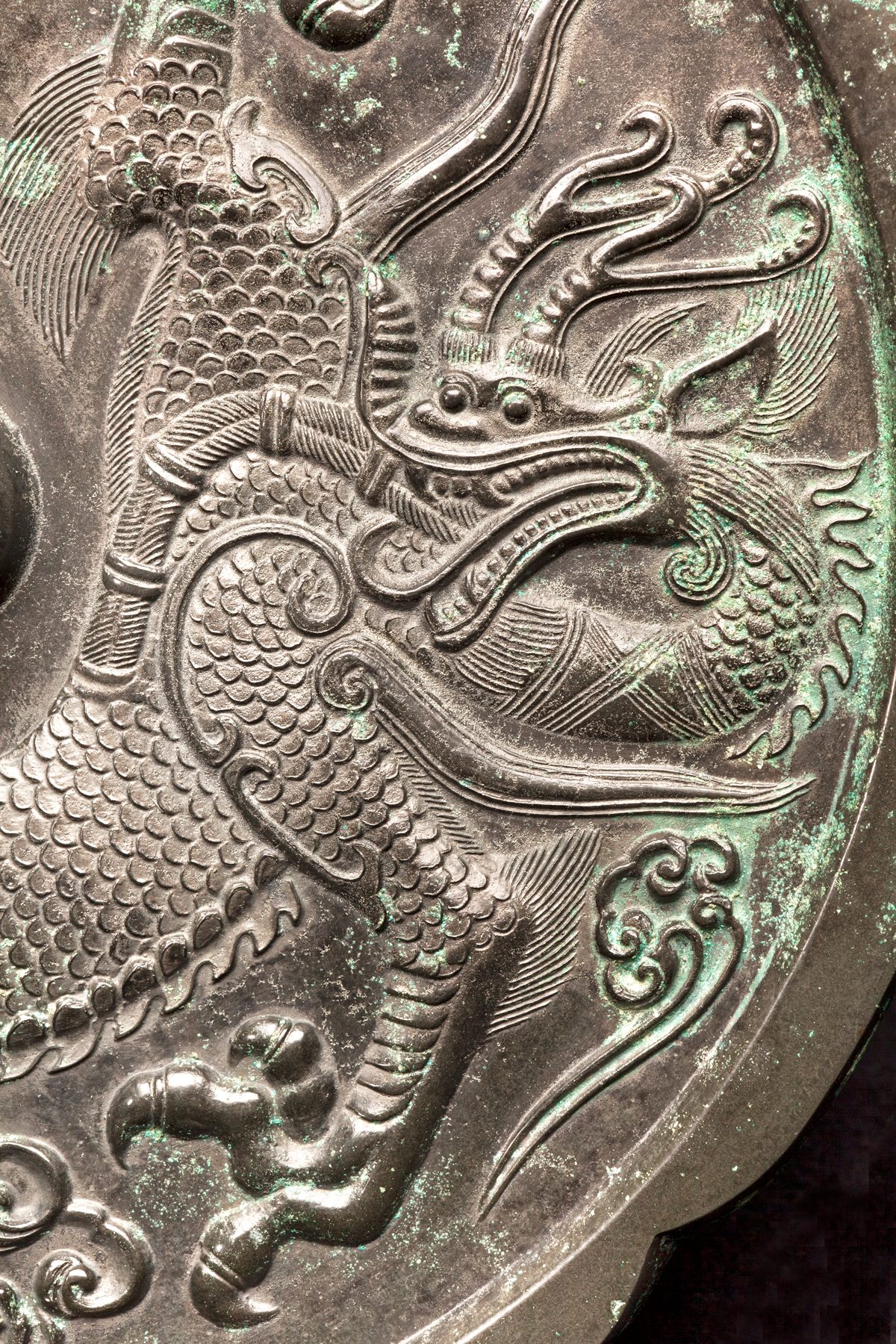
A Lobed mirror © Compton Verney, photo by Jamie Woodley